Modern businesses depend on their networks for almost everything, from email and video calls to cloud applications, ERP systems, and customer-facing portals. When a network slows down or a critical device fails, the impact is felt immediately across teams, customers, and revenue.
Yet many IT teams still learn about network problems only after users start raising complaints. Without continuous visibility, even a small issue such as a saturated link or an overloaded switch can turn into extended downtime. Real-time network monitoring helps IT teams detect, understand, and resolve these issues before they affect the business. Adit Microsys helps organizations achieve this with network monitoring solutions built on industry-leading platforms such as ManageEngine OpManager.
What Is Real-Time Network Monitoring?
Network monitoring is the continuous tracking of the health, availability, and performance of network devices and connections. This includes routers, switches, firewalls, servers, wireless access points, and virtual infrastructure.
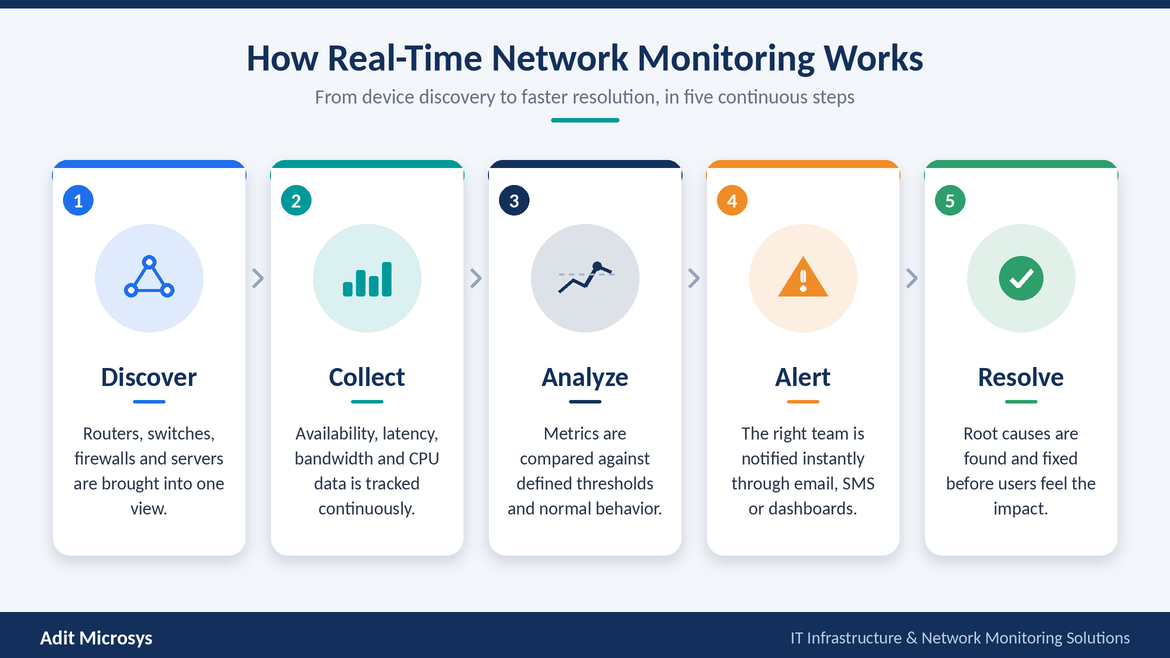
Real-time monitoring goes a step further. Instead of relying on periodic checks or manual inspections, it collects performance data continuously and alerts teams the moment a metric moves outside its normal range. The goal is simple: know about a problem before your users do.
Why Organizations Struggle Without Real-Time Monitoring
- Limited Visibility Across Devices
As networks grow, it becomes difficult to keep track of every device and connection. Without a centralized view, IT teams may not know which device is underperforming or which link is close to capacity.
- Reactive Troubleshooting
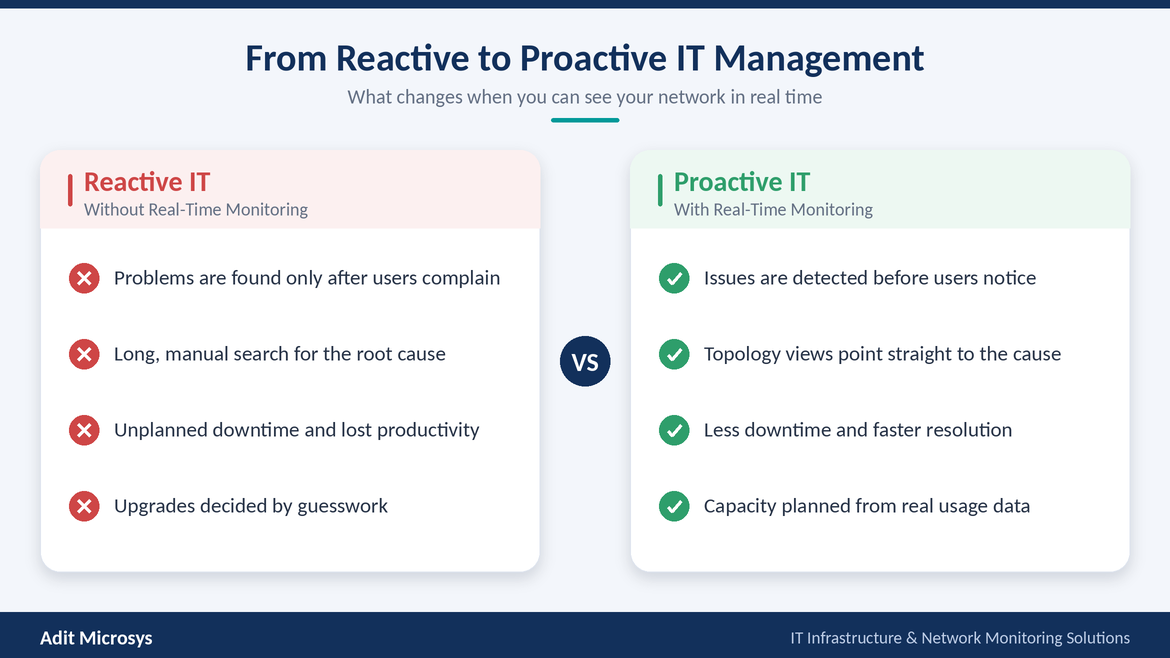
When issues are discovered only after users report them, teams spend valuable time identifying the source of the problem. Every minute spent searching for the root cause adds to downtime and productivity loss.
- Bandwidth Bottlenecks
Applications, cloud services, and remote users all compete for bandwidth. Without visibility into traffic patterns, it is hard to tell whether slowness is caused by a heavy application, a misconfigured device, or an overloaded link.
- Complex and Hybrid Environments
Today’s infrastructure often spans on-premises data centers, branch offices, and cloud platforms. Managing performance across these environments with separate tools or manual checks makes it easy for problems to go unnoticed.
How Real-Time Monitoring Improves IT Infrastructure Performance
- Detects Issues Before They Cause Downtime
Real-time monitoring tracks key indicators such as device availability, CPU and memory utilization, interface errors, and latency. When a metric crosses a defined threshold, the team is alerted immediately, allowing them to act before users are affected.
- Speeds Up Root Cause Analysis
A single failing device can trigger a chain of alerts across the network. Topology maps and dependency views help teams see how devices are connected, making it easier to identify the actual source of the issue instead of chasing symptoms.
- Optimizes Bandwidth and Capacity
Traffic analysis shows which applications and users consume the most bandwidth. This helps IT teams prioritize critical traffic, remove unnecessary load, and plan capacity upgrades based on actual usage rather than guesswork.
- Reduces Mean Time to Resolution
With clear alerts, performance history, and centralized dashboards, technicians can diagnose problems faster. Shorter resolution time means less downtime and more predictable service delivery.
- Supports Better Security Awareness
Unusual traffic spikes, unexpected device behavior, or sudden changes in network activity can be early signs of misconfiguration or security concerns. Continuous monitoring helps teams notice these patterns sooner.
Alerts That Reach the Right People
Monitoring is only effective when the right person is informed at the right time. Modern monitoring platforms support configurable thresholds and notifications through email, SMS, and other channels. Alerts can be tied to severity levels, so critical failures receive immediate attention while minor warnings can be reviewed during routine checks.
This reduces alert fatigue and helps teams focus on issues that genuinely affect business operations.
Dashboards and Reports That Support Better Decisions
Real-time dashboards give IT managers a clear view of network health across locations. Performance reports covering availability, bandwidth utilization, and device trends help teams identify recurring problems, justify infrastructure investments, and demonstrate service levels to leadership.
Instead of asking, “Is the network the reason for this slowdown?”, teams can rely on data to answer with confidence.
Works Across Your Existing Infrastructure
A good monitoring solution should fit into the environment you already have. Network monitoring platforms can discover and monitor devices from multiple vendors, along with servers, virtual machines, and wireless infrastructure, through standard protocols. This allows organizations to improve visibility without replacing existing hardware.
Move From Reactive Support to Proactive IT Management
Without real-time monitoring, IT teams are often forced into firefighting mode. Problems are discovered late, resolved under pressure, and rarely analyzed for long-term improvement.
Real-time network monitoring changes this approach. With continuous visibility, early alerts, and performance history, teams can spot trends, fix weak points, and plan upgrades before performance suffers. The result is a more stable, efficient, and predictable IT environment.
Conclusion
Improving IT infrastructure performance requires more than adding faster hardware. Organizations need continuous visibility into how their networks behave, clear alerts when something goes wrong, and reliable data to plan for growth.
Real-time network monitoring brings these capabilities together, helping businesses reduce downtime, resolve issues faster, and use their infrastructure more effectively. With its experience in IT infrastructure and its partnership with leading monitoring platforms, Adit Microsys helps organizations design, deploy, and support network monitoring that fits their environment and business needs.
Learn more about Network Monitoring by Adit Microsys: https://www.aditmicrosys.com/network-monitoring.html