As a business grows, so does the number of files it creates. Contracts, invoices, proposals, product images, presentations, training videos, and marketing creatives end up scattered across laptops, email threads, shared drives, and chat apps. What begins as a manageable collection soon becomes a maze where finding the right file takes longer than creating it.
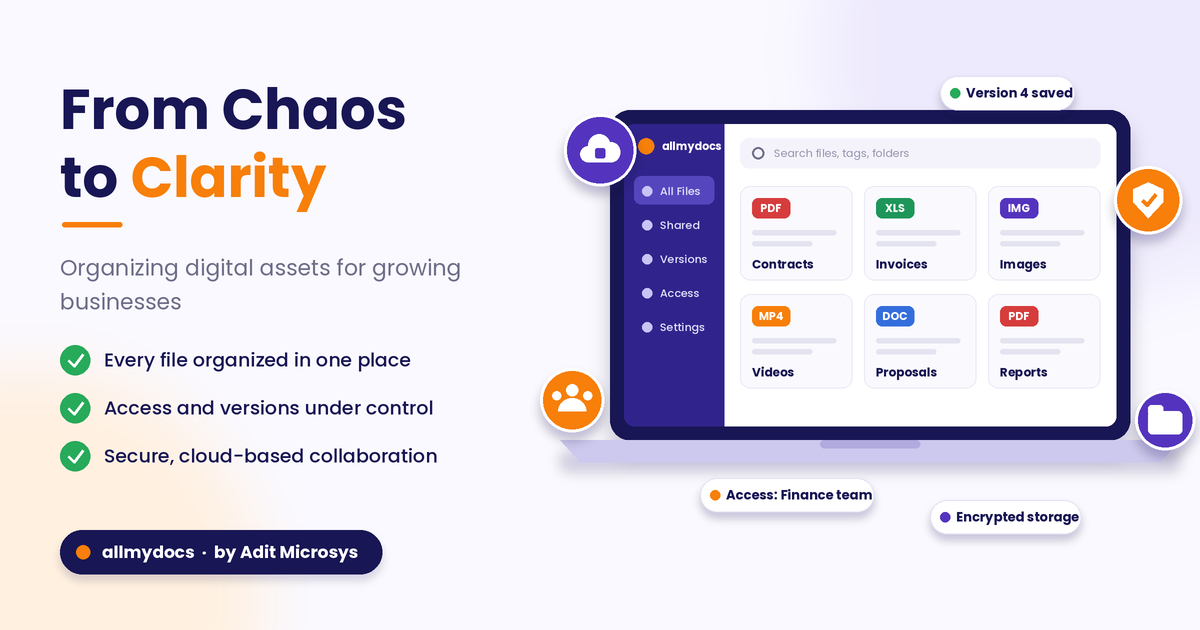
Many growing businesses still treat file organization as an afterthought. Without a structured system, even a simple request such as “send me the latest approved version” can turn into a time-consuming search and a source of costly mistakes. Digital asset management helps teams bring order to this chaos and keep every file easy to find, secure, and ready to use. Adit Microsys helps businesses achieve this with allmydocs, a cloud-based document and digital asset management solution built for small and medium-sized enterprises.
What Is Digital Asset Management?
Digital asset management (DAM) is the practice of storing, organizing, and sharing a company’s digital files from one central place. These assets include documents, images, audio, video, and other media files that the business relies on every day.
A DAM solution goes beyond simple storage. It adds structure through categorization and tagging, control through access permissions, and accountability through version history. The goal is simple: the right people find the right file at the right time.
Why Growing Businesses Struggle Without Organized Digital Assets
Scattered Files Across Multiple Places
When files live on individual computers, email attachments, and different folders, no one has a complete picture. Teams duplicate work, miss important documents, and spend valuable time asking colleagues where a file is saved.
Version Confusion
Files named “final”, “final_v2”, and “final_latest” make it hard to know which version is correct. Working from an outdated version can lead to errors, rework, and awkward conversations with clients.
Slow File Retrieval
Without consistent names, tags, or categories, searching for a file becomes guesswork. Every minute spent hunting for a document is a minute not spent on productive work.
Weak Control Over Access
As teams expand, more people need access to files, but not everyone should see everything. Without access control, sensitive documents can be shared too widely, or the right people may be unable to reach what they need.
How Digital Asset Management Brings Clarity
Brings Everything Into One Place
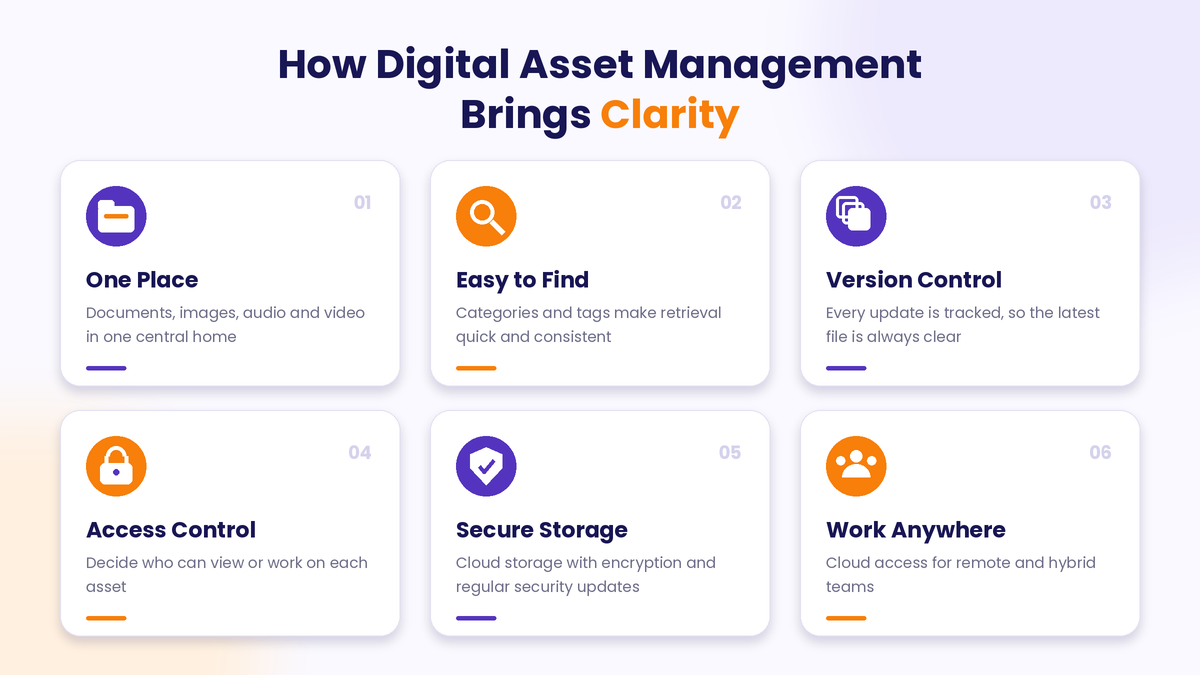
A central repository gives every document, image, audio, and video file a clear home. Teams no longer need to check several tools to find what they are looking for.
Makes Files Easy to Find
Intuitive categorization and tagging let teams organize assets in a way that matches how the business actually works. Retrieval stays quick and consistent, even as the number of files grows.
Keeps Versions Under Control
Versioning tracks every update instead of overwriting or duplicating files. Teams can work with confidence that they are using the latest file, while earlier versions remain available when needed.
Protects Sensitive Information
Access control lets businesses decide who can view or work on specific assets. Combined with secure cloud storage, encryption, and regular security updates, this helps protect important files against unauthorized access and data loss.
Supports Collaboration From Anywhere
Cloud-based access allows team members to retrieve and manage assets from any location. This supports remote and hybrid work without relying on emailing files back and forth.
Grows With Your Business
A good DAM solution should serve a small team as well as a larger organization. A scalable platform adapts as the volume of files, the number of users, and workflow needs increase.
What to Look for in a Document Management Solution
Choosing the right platform makes the difference between a tidy system and another tool that goes unused. Look for:
- Simple organization: Categories and tags that are easy for every team member to apply
- Controlled access: Permissions that can be set for specific assets and users
- Version tracking: A clear history of changes for important files
- Secure storage: Encryption and regular security updates to protect your data
- Flexible deployment: The option to run on the cloud or on-premise
- Reliable support: Onboarding assistance and a responsive support team
Cost-Effective and Easy to Adopt
A Software-as-a-Service model lets businesses pay for what they use instead of making a heavy upfront investment. With onboarding assistance and a dedicated support team, businesses can move from scattered folders to an organized system without disrupting daily work.
From Reactive Searching to Confident Management
Without a proper system, teams are often stuck in a cycle of searching, asking, and re-creating files. Mistakes are caught late, and valuable time is lost on tasks that should take seconds.
Digital asset management changes this approach. With organized files, controlled access, and tracked versions, teams spend less time looking for information and more time using it. The result is a more efficient, secure, and collaborative way of working.
Conclusion
Growth should bring more opportunities, not more confusion. As digital files multiply, businesses need a reliable way to organize them, control who can access them, and keep them available wherever teams work.
A digital asset management solution brings these capabilities together, helping businesses save time, reduce errors, and protect their most valuable files. With allmydocs, Adit Microsys helps growing businesses turn document chaos into clarity through a secure, scalable, and cost-effective platform.
Learn more about Document Management by Adit Microsys: https://www.aditmicrosys.com/digital-asset-management.html