An online store is more than a website with a shopping cart. It brings together a storefront, payments, inventory, order management, marketing tools, and customer data, and every one of these parts depends on the technology underneath it. The choices made at the start decide how fast the store loads, how securely it handles payments, and how easily it grows with the business.
Many businesses pick a platform based on price or popularity and discover the limits a year later, when traffic grows, the catalogue expands, or a new sales channel is needed. Choosing the right technology stack early saves rework, migration costs, and lost sales. Adit Microsys helps businesses make this choice and build e-commerce stores that are ready to scale.
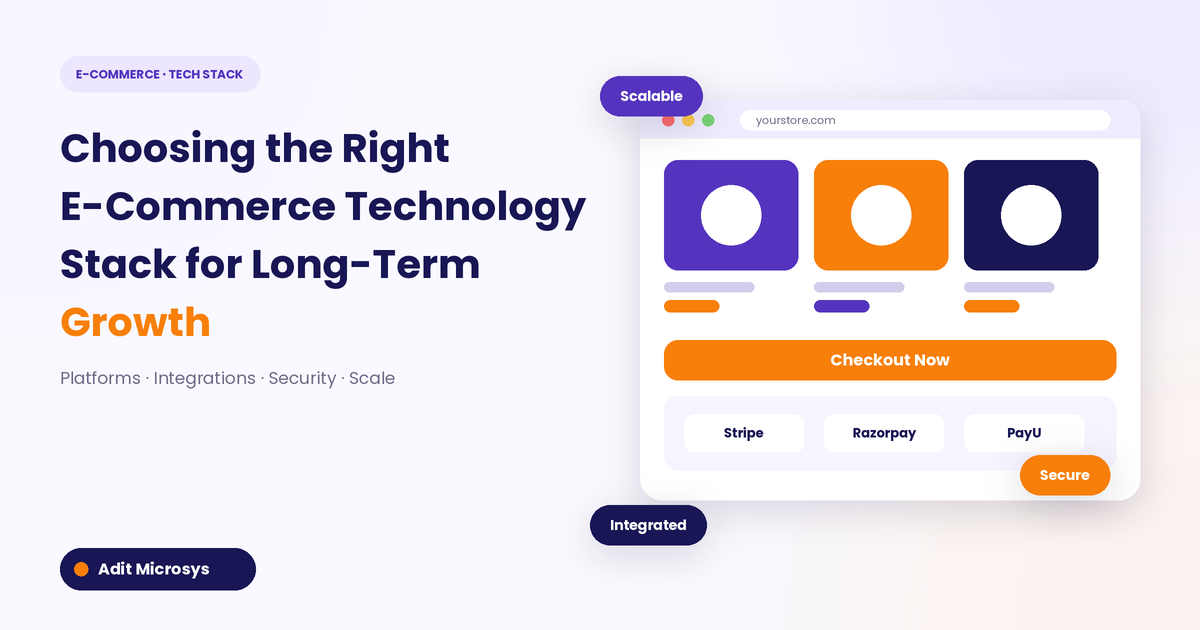
What Is an E-Commerce Technology Stack?
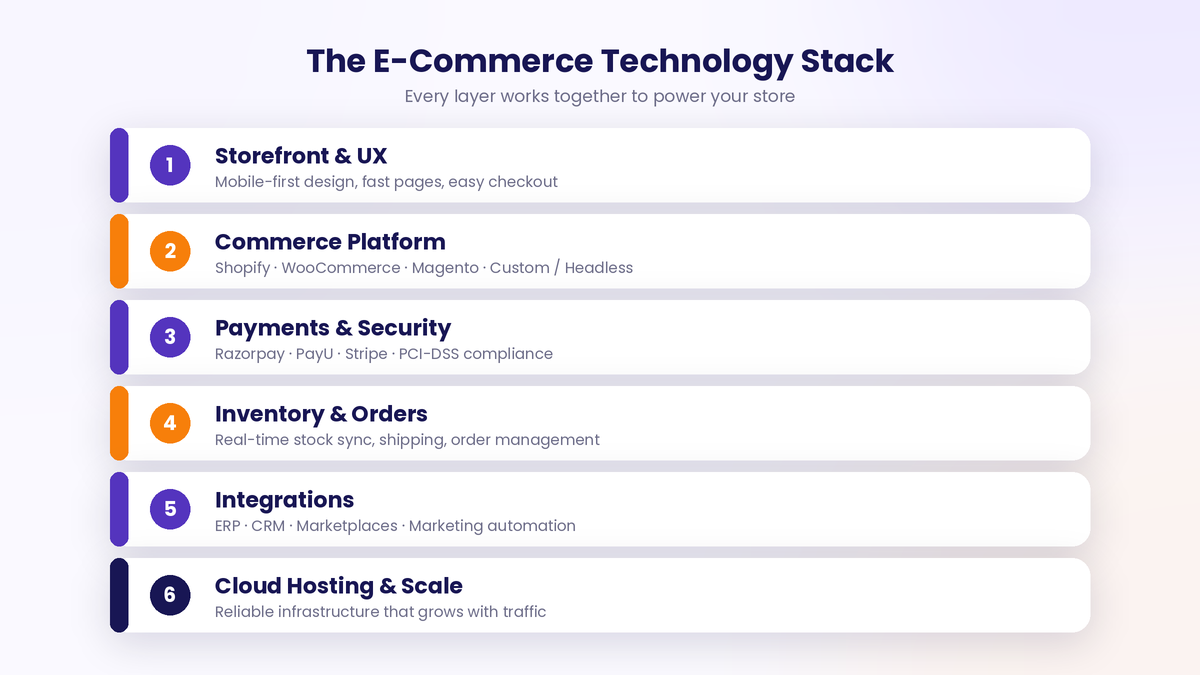
An e-commerce technology stack is the combination of platforms, tools, and integrations that together run an online store. A typical stack includes:
- E-commerce platform: Magento, WooCommerce, Shopify, BigCommerce, or a custom-built solution
- Storefront and user experience: The design, navigation, and checkout flow customers interact with
- Payment gateways: Integrations such as Razorpay, PayU, and Stripe
- Hosting and security: Servers, SSL certificates, and protection for customer data
- Inventory and order management: Stock tracking, order processing, and reporting
- Business integrations: ERP, CRM, accounting, marketing automation, and marketplaces
Why the Wrong Technology Stack Becomes Expensive
Limited Scalability
A platform that works for fifty products may struggle with five thousand. When traffic spikes during a sale or festive season, a stack that cannot scale leads to slow pages, failed checkouts, and lost revenue.
Slow and Hard-to-Use Stores
Shoppers expect fast pages and a smooth path from homepage to checkout. Heavy themes, poor hosting, and cluttered navigation increase bounce rates and push customers toward competitors.
Disconnected Systems
When the store, inventory, accounting, and marketplace listings run separately, teams re-enter data by hand. This causes stock mismatches, delayed orders, and avoidable errors.
Security and Compliance Gaps
Online stores handle personal and payment data. Without secure checkout, SSL, and compliant payment integrations, a business risks both customer trust and legal trouble.
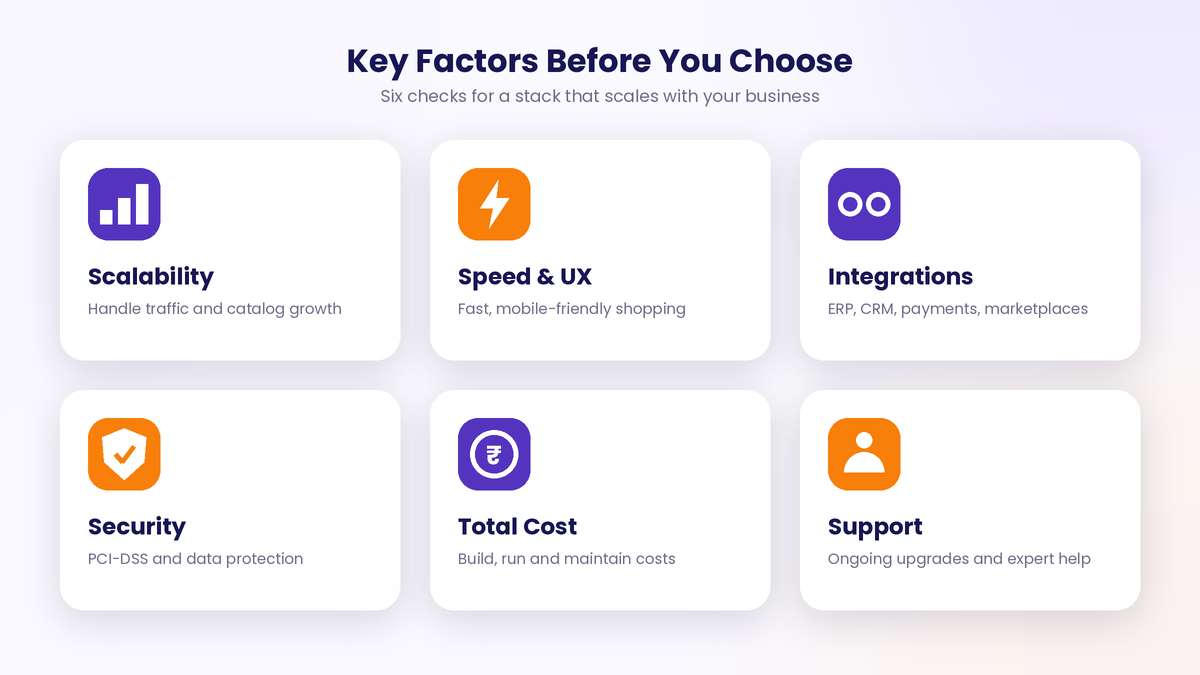
Key Factors to Consider Before You Choose
Before selecting a platform, evaluate it against what your business actually needs:
- Business size and growth plans: Choose for where you want to be in two to three years, not only for today
- Catalogue complexity: The number of products, variants, and categories affects performance and platform choice
- Customization needs: Standard themes may be enough, or you may need unique features and workflows
- Budget: Consider setup cost, ongoing maintenance, and the cost of future upgrades
- Integrations: Check compatibility with your ERP, CRM, accounting software, and payment gateways
- Mobile experience: A large share of shoppers browse and buy on smartphones, so the store must be mobile-first
- Security: Secure payments, SSL, and regular updates should be built in
- Support: Reliable development and maintenance support after launch
Choosing the Right Platform
Shopify
A hosted platform that is generally quicker to launch and easier to manage. It suits businesses that want to get started fast with limited technical effort.
WooCommerce
Built on WordPress, it offers flexibility, a wide plugin ecosystem, and strong content and SEO capabilities. It suits businesses that want control over design and features.
Magento
A powerful platform designed for large catalogues and complex requirements. It suits growing and enterprise-level businesses that need deep customization.
Custom, Headless, and Microservices Solutions
For businesses with unique workflows or very high scale, custom-built or headless commerce architectures offer maximum flexibility. They require more planning, so they are best chosen after a proper consultation.
Essential Capabilities Every Stack Should Support
Whichever platform you choose, make sure the stack delivers these basics:
- Fast, mobile-responsive design: Better experience for shoppers and better search visibility
- Smooth cart and checkout: Guest checkout, coupons, shipping options, and preferred payment methods
- Secure payment integration: Support for local and global currencies through trusted gateways
- Marketplace integration: Syncing with channels such as Amazon, Flipkart, and Facebook
- Inventory and order management: Automatic stock syncing, low-stock alerts, and real-time sales reports
- Business system integrations: ERP, CRM, accounting, and marketing automation connected to the store
Planning for Migration and Future Growth
Sometimes the stack you already have no longer fits. Moving from one platform to another, such as Magento to WooCommerce, is a common step for businesses that want simpler management or lower costs. With careful planning, products, customers, orders, SEO URLs, and plugins can be moved without disrupting the business or losing search rankings.
It also pays to think ahead. Choose a stack that can add new sales channels, new payment options, and a mobile app later, without rebuilding the store from scratch.
Why a Technology Partner Matters
The platform is only part of the answer. How it is designed, built, secured, and maintained decides the results. A good development partner helps you:
- Choose the right platform based on your goals, not a one-size-fits-all recommendation
- Design for conversion, guiding shoppers from homepage to checkout
- Integrate your systems so inventory, orders, and accounts stay in sync
- Keep the store secure and fast through monitoring, maintenance, and updates
Conclusion
The right e-commerce technology stack is not the most popular one. It is the one that fits your business today and can grow with you tomorrow. Scalability, security, integrations, and a smooth shopping experience should guide every decision.
With the right foundation, an online store becomes a dependable growth engine instead of a recurring technical problem. Adit Microsys helps businesses plan, build, migrate, and support e-commerce stores on Magento, WooCommerce, Shopify, and custom platforms, so growth is never held back by technology.
Learn more about E-commerce Development by Adit Microsys: https://www.aditmicrosys.com/ecommerce-website-development.html