Why Businesses Are Using AI in Existing Systems
What if your existing IT systems could think, predict, and automate decisions on their own without rebuilding everything from scratch? Today, businesses using AI are seeing up to 40% efficiency gains and faster decision-making.
The good news is you don’t need to replace your current infrastructure to achieve this. With the right approach, AI can seamlessly enhance what you already have and turn it into a smarter, more powerful system.
Real Examples of AI in Business
For example, companies like Amazon use AI within their existing systems to recommend products, while banks use it to detect fraud in real time without replacing their core software.
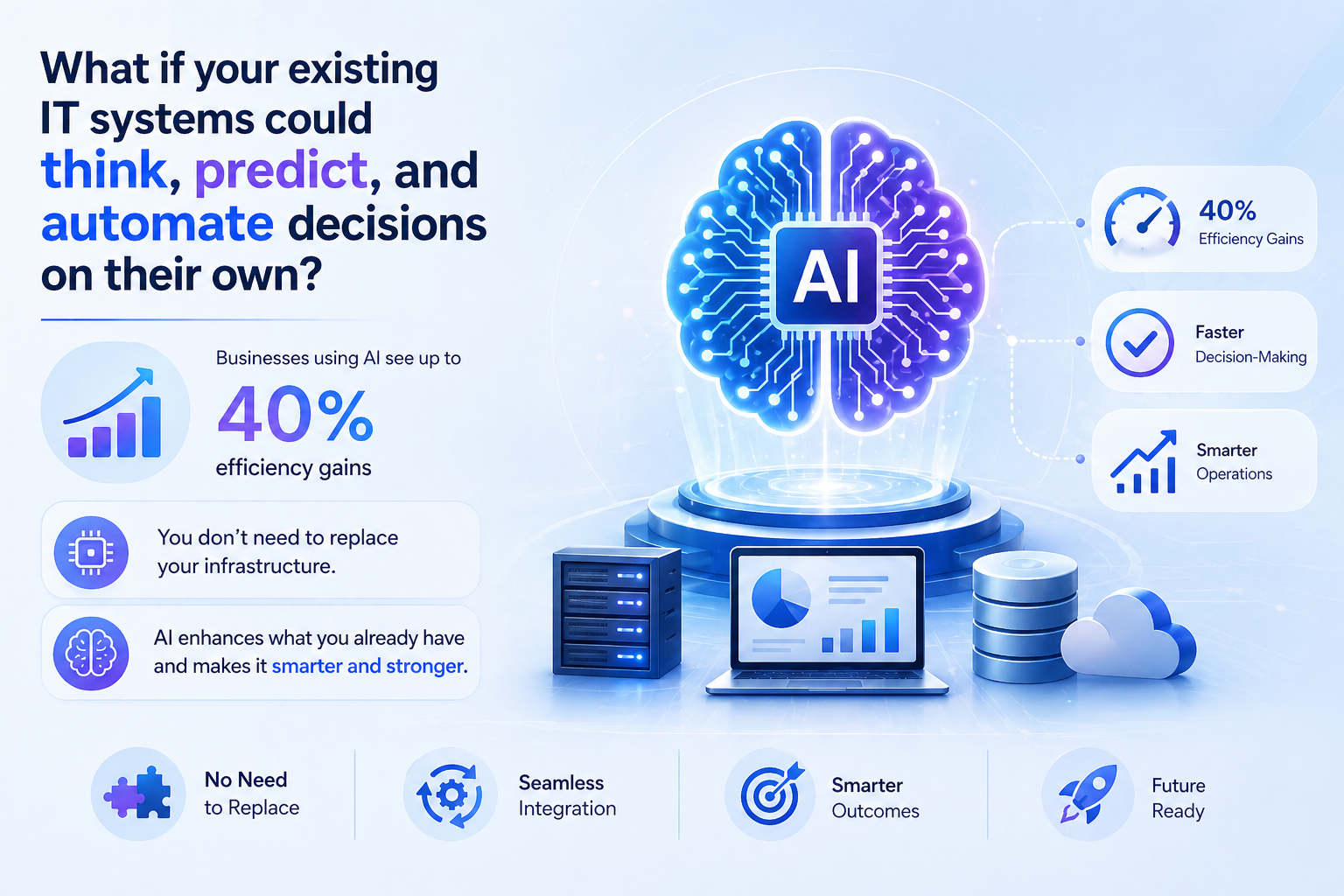
Businesses that adopt AI effectively can increase productivity by up to 40% and reduce operational costs by nearly 30%, making AI one of the most impactful technologies in modern IT systems.
For instance, a mid-sized eCommerce company integrated an AI chatbot into its existing website and reduced customer response time by 60%, while increasing lead conversions by 25% within just three months.
What is AI Integration?
AI integration involves embedding intelligent technologies, such as machine learning, natural language processing, and automation into your current software, applications, and workflows.
Instead of replacing systems, AI enhances them by making processes smarter, faster, and more efficient.
- Identify Business Needs and Use Cases
The first step in AI integration is to understand where it can deliver the most value.
Ask questions like:
- Which processes are repetitive and time-consuming?
- Where do we need better insights or predictions?
- How can customer experience be improved?
Common AI use cases include:
- Customer support chatbots
- Predictive analytics for sales
- Fraud detection
- Personalized marketing
Starting with a clear use case ensures your AI implementation aligns with business goals.
- Evaluate Your Existing IT Infrastructure
Before integrating AI, businesses must assess their current systems.
Key factors to evaluate:
- Data availability and quality
- Software compatibility
- System performance and scalability
- Security standards
AI systems rely heavily on data. If your data is unstructured or outdated, it may need cleaning and organization before integration.
- Choose the Right AI Tools and Platforms
Not every business needs to build AI from scratch. Many ready-to-use AI tools and platforms can integrate easily with existing systems.
Options include:
- Cloud-based AI services
- AI-powered APIs
- Pre-trained machine learning models
These solutions reduce development time and allow businesses to start small while scaling gradually.
- Start Small with Pilot Projects
Instead of implementing AI across the entire organization, it begins with a pilot project.
For example:
- Automate customer queries with a chatbot
- Use AI for email filtering or lead scoring
- Implement predictive analytics for a single department
Pilot projects help test feasibility, measure ROI, and identify challenges before full-scale deployment.
- Integrate AI with Existing Applications
AI can be integrated into existing systems using APIs and middleware.
For example:
- CRM systems can use AI for customer insights
- ERP systems can automate supply chain decisions
- Marketing platforms can use AI for personalization
This approach ensures minimal disruption while enhancing system capabilities.
- Focus on Data Integration and Management
Data is the backbone of AI.
Businesses must ensure:
- Data is centralized and accessible
- Systems can communicate with each other
- Real-time data processing is possible
Using cloud-based data storage and management solutions can simplify this process and improve efficiency.
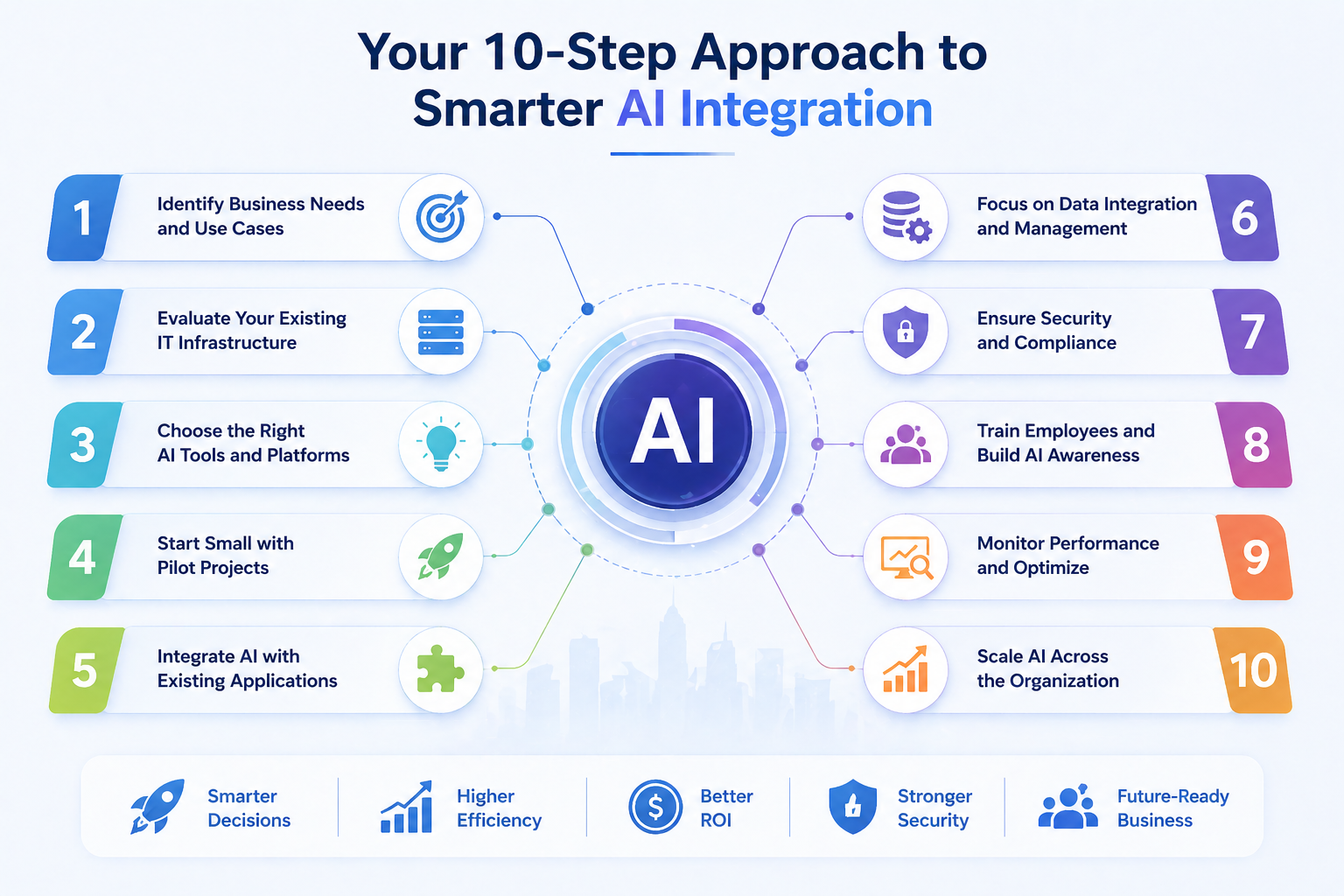
- Ensure Security and Compliance
AI integration introduces new security challenges.
Businesses should:
- Protect sensitive data with encryption
- Follow data privacy regulations
- Monitor AI systems for vulnerabilities
A secure AI system builds trust and ensures compliance with industry standards.
- Train Employees and Build AI Awareness
Technology alone is not enough people who play a crucial role in successful AI adoption.
Provide training to:
- Help employees understand AI tools
- Improve collaboration between teams
- Encourage innovation and experimentation
A skilled workforce ensures maximum value from AI investments.
- Monitor Performance and Optimize
AI integration is not a one-time process. Continuous monitoring is essential.
Track metrics like:
- Efficiency improvements
- Cost savings
- Customer satisfaction
- System performance
Use these insights to refine and optimize AI systems over time.
- Scale AI Across the Organization
Once AI proves successful in pilot projects, businesses can expand their use across departments.
Scaling AI can lead to:
- Organization-wide automation
- Better decision-making
- Increased competitiveness
A phased approach ensures smooth adoption without overwhelming existing systems.
Benefits of AI Integration:
Businesses that integrate AI effectively can achieve:
- Improved Efficiency
Automate repetitive tasks and reduce manual effort
- Better Decision-Making
Use data-driven insights for smarter strategies
- Enhanced Customer Experience
Deliver personalized and faster services
- Cost Reduction
Optimize operations and reduce resource usage
- Competitive Advantage
Stay ahead in a rapidly evolving market
Challenges and Solutions:
- Lack of Quality Data
Solution: Invest in data cleaning and management tools
- Integration Complexity
Solution: Use APIs and cloud-based solutions
- High Initial Costs
Solution: Start small and scale gradually
- Resistance to Change
Solution: Train employees and promote AI awareness
Future of AI in Business:
AI is becoming a core part of modern IT infrastructure. From automation to predictive analytics, its applications are expanding rapidly.
Businesses that adopt AI early will:
- Innovate faster
- Improve operational efficiency
- Deliver superior customer experiences
In the coming years, AI will not just support IT systems, it will drive them.
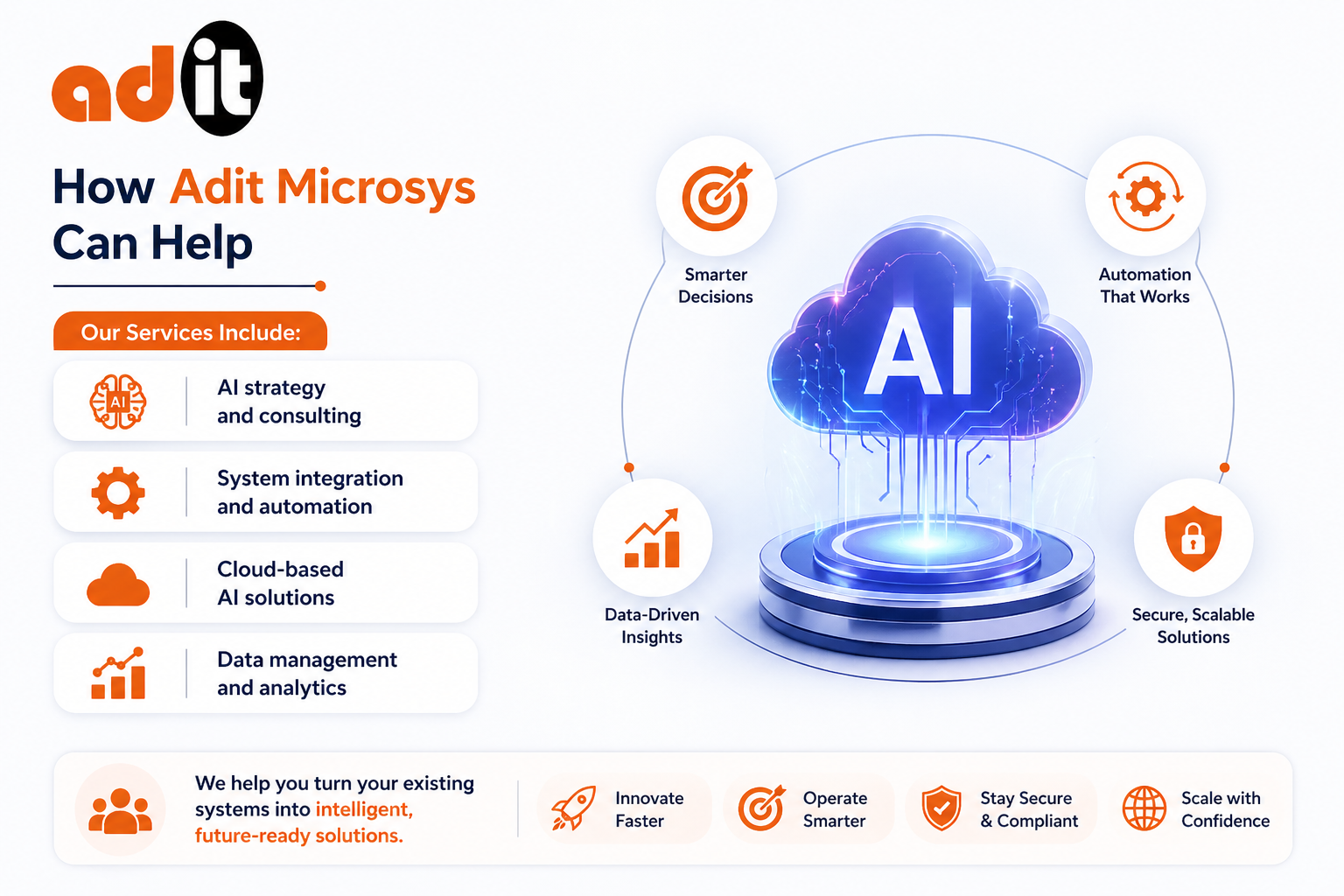
How Adit Microsys Can Help:
At Adit Microsys, we specialize in integrating AI solutions into existing IT systems without disrupting your business operations.
Our services include:
- AI strategy and consulting
- System integration and automation
- Cloud-based AI solutions
- Data management and analytics
We help businesses transform their IT infrastructure into intelligent, future-ready systems.
Conclusion:
Integrating AI into existing IT systems doesn’t have to be complex or costly. With the right approach starting small, focusing on data, and using scalable tools, businesses can unlock the full potential of AI.
As technology continues to evolve, AI integration will become a key driver of business success. Companies that embrace it today will be better positioned to lead tomorrow.